



WoW TBC Classic Boost Guide
The launch of WoW: The Burning Crusade Classic Anniversary edition has re-ignited interest in Outland and endgame content on fresh “Anniversary” realms. These special servers give players a chance to start anew in TBC Classic, and boosting services have quickly become a trending topic. Boosting refers to paying (in in-game gold or real money) for assistance to speed up progression – from leveling and dungeon runs to raid clears. With so many returning players and limited time events, TBC Classic boosting services and their prices are in the spotlight. Many players are actively comparing offers on Anniversary realms to find the best value and ensure they don’t fall behind in the race through TBC content. In this guide we will describe all the information about boosting services on TBC Classic and why players use them.
What Is WoW TBC Classic Anniversary Boosting
In TBC Classic Anniversary, boosting means experienced players or teams “carry” a customer’s character through content for fast rewards. This can happen in two ways: self-play (you control your character and tag along while boosters do the heavy lifting) or piloted (you share your account, and a booster plays your character for you). Common boost formats include powerleveling (rapid leveling to 70), dungeon clears, raid carries, PvP rank climbing, and more. When done correctly – i.e. manually by real players without cheats or exploits – boosting remains legal within Blizzard’s rules. Essentially, getting help from others for tough quests or raids is part of the game’s social fabric, so long as the methods don’t violate any policies. Boosting services simply organize this help for a fee, providing a shortcut through the grind while sticking to fair play guidelines.
WoW TBC Classic Anniversary Boost Price Comparison
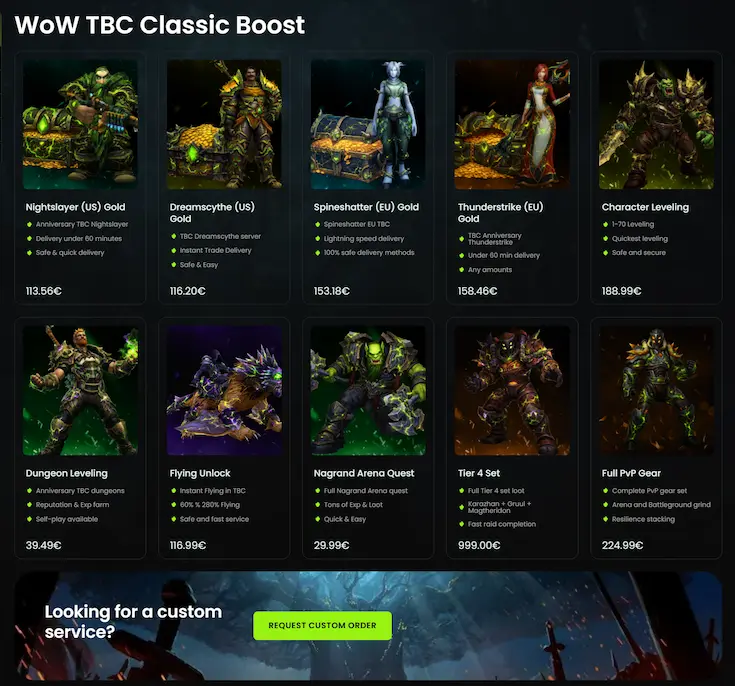
To give a clearer picture, the table below compares average boost price ranges for different services in WoW TBC Classic Anniversary. Prices are approximate, listed in both USD and EUR, and popularity indicates current demand. Each service includes an example link to a typical offering (for reference):
| Service | Price Range (USD) | Price Range (EUR) | Popularity |
|---|---|---|---|
| Raid Boosts | $50–$150+ | €50–€140+ | Very High |
| Dungeon Boosting | $5–$30 per run | €5–€30 per run | High |
| Attunement Services | $50–$120 | €45–€110 | High |
| Reputation Grinding | $30–$100 | €30–€90 | Medium |
| Power Leveling | $150–$250 | €140–€230 | Very High |
| PvP Boosting | $50–$200 | €45–€180 | High |
Note: The price ranges above are averages for the Anniversary realm market as of now. Actual prices can fluctuate based on phase (e.g. later Phase 3–4 services like Black Temple or Sunwell might command the higher end of the range). Popularity indicates relative demand: for instance, nearly every player can use a raid or leveling boost (hence “Very High”), whereas a more niche service like specific rep farming might see moderate use. All example links are representative services offered commercially (without endorsing any particular provider).
Most Popular Boosts in TBC Classic Anniversary
Boosting providers offer a wide array of services, but a few categories stand out as the most popular on Anniversary realms:
-
Raid Boosts (Karazhan, SSC, TK, Hyjal, Black Temple, Sunwell): Raid carry services allow players to join a professional raid group and defeat bosses for loot without managing their own guild or pug. These are extremely popular because raids drop the best gear (e.g. Tier sets, legendary Warglaives) and many players want a guaranteed clear each week. From Karazhan in Phase 1 to Sunwell Plateau in later phases, raid boosts let customers experience the content and collect loot with no wipe nights or scheduling hassles – a big reason popularity is very high here.
-
Dungeon Boosting: This refers to being carried through 5-player dungeons (normal or heroic). In TBC Classic, dungeon boosts serve two main purposes: power-leveling and farming loot or reputation. For example, a max-level booster might speed-run Slave Pens or Shadow Labyrinth with a low-level client in tow, yielding fast XP and quest completion. Dungeon boosting is in high demand especially during leveling and attunement stages, since it saves players from the trouble of finding groups and allows efficient reputation farming for heroics.
-
Attunement Services: TBC raids often require special attunements – multi-step quest chains or challenges to unlock entry. Boosting services complete these attunements on behalf of players. Karazhan attunement (the Master’s Key quests across several dungeons) and Heroic Dungeon attunements (reaching Revered with five factions for keys) are prime examples. These services are popular because attunements can be tedious and time-intensive. By purchasing an attunement boost, a player can become “raid-ready” or “heroic-ready” in a fraction of the time, which is invaluable on a fresh realm where everyone is rushing to endgame.
-
Reputation Grinding: Beyond attunements, TBC has many reputations (Aldor/Scryer, Sha’tar, Netherwing, etc.) that grant important rewards at Exalted. Reputation boost services involve a booster farming repeatable rep sources (dungeons, quests, turn-ins) to raise the client’s standing quickly. This is especially useful for unlocking epic flying mounts, obtaining unique gear/enchants, or simply accessing content gated behind rep. It’s a moderately popular service – crucial for certain goals like heroic dungeon access or shoulder enchants, though some players choose to grind rep themselves if they have time.
-
Leveling Boosts: Leveling from 1 to 70 in TBC Classic is a long journey – often taking weeks of played time. Many Anniversary realm players opt for powerleveling boosts to skip directly to max level. Boosters will either quest efficiently on the account or employ techniques like chained dungeon runs to gain XP rapidly. Leveling boosts (including the special level 58 boost available in TBC pre-patch) are very popular because they allow players to jump into Outland endgame content without the vanilla-leveling slog. This is especially true for those rolling new Blood Elf or Draenei characters from level 1, or anyone who didn’t use Blizzard’s one-time boost and doesn’t want to lag behind guildmates.
-
PvP Boosting: TBC introduced Arenas and a new honor system, making PvP progression another grind-heavy aspect of the game. PvP boost services typically offer arena rating carries – pairing the customer with high-skilled gladiator boosters to achieve a target rating (e.g. 1850 for weapon, 2000+ for titles). They also offer honor farming, where a booster plays battlegrounds to farm Honor Points and Marks for the client’s gear. PvP boosting is quite popular among players who want prestigious titles or Season gear without enduring countless losses. However, it tends to attract a niche of competitively minded players, so its popularity is a bit more modest compared to PvE boosts. Many others prefer to grind PvP themselves for the challenge, keeping this service in the medium-to-high demand range.
Why Paid Services Demand Is High in TBC Classic Anniversary
Several factors have driven high demand for boosts on Anniversary realms, rooted in both game mechanics and player lifestyles:
-
Time-Gated Content & Attunements: TBC content famously gates raids behind lengthy attunement quests and reputation grinds. With phases unlocking on a schedule, many players want to complete attunements (like the Karazhan key quest or Heroic dungeon rep requirements) as fast as possible. Boosting offers a shortcut through these time-consuming prerequisites.
-
Raid Lockouts & Roster Pressure: Progression raids in TBC have weekly lockouts and require a full roster of geared, attuned players. Guilds on fresh realms feel pressure to fill spots with capable characters quickly. Boosting helps new or undergeared players catch up so they can contribute to weekly clears, easing roster stress for raid teams.
-
Competitive Gearing & Progression: Whether it’s chasing PvE world firsts or climbing PvP arena rankings, the Anniversary realms have a competitive edge. Early on, even a small gear or level advantage is huge. Many players invest in boost services to obtain powerful gear and TBC Classic boost rewards faster, ensuring they stay ahead of the average progression curve.
-
Nostalgia vs. Limited Playtime: A large portion of the Anniversary playerbase are veterans returning for nostalgia – they love TBC, but now have jobs, family, and limited free time. Boosting is an attractive solution for these players to relive endgame content without the original 2007-era grind. In short, the market dynamics favor boosting: high player interest, a condensed progression timeline, and fewer hours to play all translate into strong demand for carries and time-saving services.
How Prices Are Formed in TBC Classic Anniversary
Boosting prices in TBC Classic Anniversary are driven by a mix of gameplay factors and market forces. There is no fixed “price tag” for a boost – instead, prices reflect the effort, risk, and demand associated with each service:
-
Content Difficulty & Time Investment: The more time-consuming or challenging a boost, the higher its cost. For example, a full 1–70 leveling boost (dozens of hours of playtime) naturally costs far more than a quick single-dungeon clear. Similarly, late-phase raid content like Sunwell Plateau requires extremely skilled teams and longer runs, so a Sunwell boost is priced higher than an easier Tier 4 raid like Karazhan. Boost providers factor in the labor required – if a service takes a dedicated team multiple hours or weeks (in the case of repeated runs), the price will scale accordingly.
-
Supply and Demand Dynamics: The boost cost also responds to player demand on the Anniversary realms. In the early weeks, demand is sky-high (everyone is leveling, attuning, gearing at once) while the supply of geared boosters is relatively low – this can push prices up. As the realm matures and more boosters become available, competition may drive prices down a bit for routine services. For instance, the cost of a Heroic dungeon attunement might be premium in week 1, but lower a month later once many players have naturally attained Revered rep. Providers continuously adjust prices to remain competitive while meeting the shifting needs of the playerbase.
-
Loot and Guarantee Factors: Some boosts offer guaranteed loot or rewards, which can raise the price. A straightforward “participation” raid carry (no guaranteed items) will be cheaper than a loot reserved run where specific drops (e.g. a Tier token or legendary) are guaranteed to the buyer. Essentially, if the service includes securing rare items or completing RNG-based goals, it will cost extra to compensate the boosters for potentially multiple runs. Clarity on loot distribution is often part of the pricing – customers pay more for certainty.
-
Anniversary vs. Regular Classic Pricing: Prices on Anniversary realms can differ from those on long-established Classic servers. On fresh realms, in-game gold is scarce early on, so paying in gold for boosts is less common (many turn to real-currency services). Real-money boost prices on Anniversary may actually start higher due to the frenzy of initial demand and the novelty of content – players are willing to pay a premium to be among the first at level 70 or in epic gear. Over time, as the content becomes more routine, prices tend to normalize or even drop to “regular Classic” levels. In summary, Anniversary boost pricing is dynamic: it mirrors the difficulty of the task and the eagerness of players to bypass that task, without ever guaranteeing outcomes beyond what is explicitly offered.
What Players Should Consider Before Buying a Carry
Before purchasing any boost service, players should approach it like informed consumers. Key factors to consider include:
-
Account Safety: Ensure the service is safe and reputable. This means boosters should use no bots, hacks, or exploits that could get your account penalized. If it’s a piloted boost, check that the provider takes security measures (VPN usage matching your location, etc.) to avoid flagging Blizzard’s account-sharing detection. It’s wise to read reviews or get recommendations – your account’s security comes first.
-
Service Transparency: A good boost offer will clearly state what’s included and how it works. Look for details on loot rules, timeframes, and requirements. For example, if you buy a raid carry, do they guarantee a certain number of loot drops or just a clear? For leveling, will you keep all gold and loot obtained? Make sure the provider is transparent about any random outcomes (no one can guarantee a specific drop unless explicitly offering a loot reservation). Clarity up front prevents disappointments later.
-
Communication and Support: Clear communication is essential for a smooth boost. Choose services that offer active customer support or a way to chat with your boosters. You’ll want to coordinate things like scheduling (when the boost will happen), any play preferences, or questions you have. Professional boosters will keep you updated during the process. If a provider seems unresponsive or vague in communication, that’s a red flag – you need to be confident you can reach them if any issue arises.
-
Delivery Method & Play Style: Decide what method suits you: self-play vs. piloted. Self-play boosts let you participate on your character and are inherently safer (no account sharing), but they require you to be present at the scheduled time. Piloted boosts are more hands-off – the work gets done while you’re offline – but you must be comfortable with someone else on your account (within agreed terms). Also consider region and time zone – ensure the boosters operate on your realm’s schedule. Lastly, check the estimated completion time. For lengthy services (e.g. leveling), know whether it will take days or weeks and plan accordingly.
By weighing these factors, players can make an educated decision and have a positive, stress-free boosting experience if they choose to use one.
The boosting market in TBC Classic Anniversary has quickly become an integral part of the game’s ecosystem, reflecting the community’s desire to balance nostalgia with efficiency. From raid carries to leveling packages, there’s a wide range of options available at various price points. As we’ve seen, comparing boost prices and services is now almost as important as comparing gear upgrades – savvy players do their research to find the best fit for their needs. Ultimately, the resurgence of boosting in TBC Classic Anniversary underlines how valued time has become for the playerbase. By understanding the offerings, prices, and precautions, fans of Outland can make informed choices on whether (and how) to invest in a boost, ensuring they get the most out of this celebratory return to The Burning Crusade without breaking the bank or the rules. The landscape is neutral and pragmatic: boosting is there as a convenience, and it’s up to each player to decide how it fits into their journey beyond the Dark Portal.

